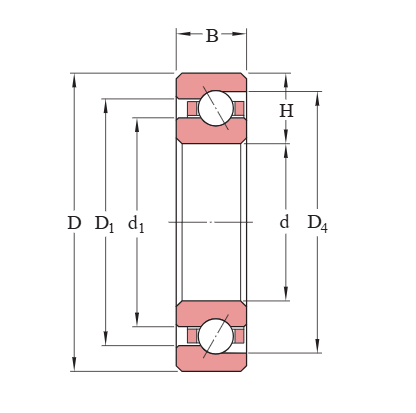
Thin section bearings.
Alternative to Kaydon.
Accuracy class:P5/P4/P2 level
Dimensions: 165.1 * 177.8 * 6.35 mm
Weight: 0.136KG
Bearing ring material: GCr15 (AISI 52100) bearing steel(440C Stainless Steel)
Retainer: One-piece brass cage (Bronze)
Rolling element: GCr15 Precision Steel Ball
Structure: Single-row angular contact ball bearings
Dimensions in Inches | Capacities in Pounds |
Approx.Wt. In lbs. |
Size
| Land Diameters | Dynamic | Static |
Bore | Outside Dia. | L1 | L2 | C’BoreL3 | ISO Radial | Thrust | Radial | Thrust |
6.500 | 7.000 | 6.686 | 6.814 | 6.861 | 1605 | 2000 | 2370 | 6830 | .30 |
Thin Section Bearings are extra thin section bearings, with square cross-sections for both inner and outer rings, and the cross-sectional dimensions are consistent.The whole is composed of an inner ring, an outer ring, rolling elements, and a retaining structure.Based on the raceway form, there are three types of structures: deep groove ball, angular contact, and four-point contact, most of which are open designs.Cages are used to separate and hold rolling elements in place.The angular contact structure has a fixed contact angle and can withstand radial and unidirectional axial loads; the four-point contact structure can withstand bidirectional axial loads.The bearings have uniform wall thickness, compact shape, small installation space, and are suitable for various precision automated equipment.
Three main materials are used for thin Section Bearings.The standard model features high-carbon chromium bearing steel for the inner and outer rings and rolling elements, making it suitable for conventional drying conditions.The corrosion-resistant version features stainless steel inner and outer rings and rolling elements, making it suitable for humid and corrosive working environments.The ceramic hybrid version adopts a composite structure, with the inner and outer rings made of bearing steel and the rolling elements made of ceramic material, making it suitable for special working conditions such as high speed, low friction, and high temperature resistance.All cages are typically made of nylon or brass and are responsible for separating and positioning the rolling elements, providing structural support for stable bearing operation.
The precision of thin Section Bearings is divided into two levels: P5 and P4.The tolerances for the inner diameter, outer diameter, and width of P5 grade bearings are within the normal range, while the specified values for the roundness and cylindricity errors of the bearing rings are larger than those for P4.The P4 grade compresses the dimensional tolerance range and reduces the geometric error of the raceway.The P5 raceway profile deviation standard is more lenient, while the P4 raceway dimensional accuracy is higher.Both levels of precision have fixed tolerance standards, and all dimensions and geometric errors are controlled according to the corresponding level. The machining precision of the parts corresponds one-to-one with the level.The bearing precision can be selected according to different working conditions, taking into full account factors such as applicable range and cost performance.