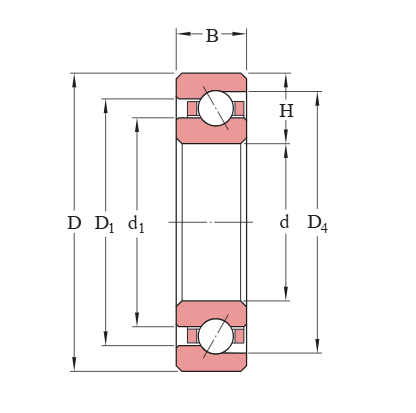
The KC040AR0 is an open-type, constant-section, 30° angular contact bearing with a 4-inch imperial bore; the rings and balls are made of GCr15 bearing steel, and it features a brass cage. R0 features standard, small internal clearance and supports radial and unidirectional axial loads; paired mounting enables it to handle bidirectional thrust. Lightweight and space-saving, it is commonly used in robot joints, optical turntables, and precision inspection equipment.
Dimensions in Inches | Capacities in Pounds |
Approx.Wt. In lbs. |
Size | Land Diameters | Dynamic | Static |
Bore | Outside Dia. | L1 | L2 | C’BoreL3 | ISO Radial | Thrust | Radial | Thrust |
4.000 | 4.750 | 4.277 | 4.473 | 4.554 | 2,250 | 2,770 | 2,550 | 7,360 | .44 |
Thin section bearings are composed of four basic components: inner ring, outer ring, steel ball and cage.The cross-sectional dimensions of the inner and outer rings of bearings of the same series remain consistent, with uniform cross-sectional specifications and uniform wall thickness, and the cross-sectional size will not change as the inner diameter increases. An annular raceway is processed on the inside of the inner and outer rings, and the steel balls are evenly arranged in the middle of the two sets of raceways. The cage evenly separates the steel balls, fixes the position of the rolling elements, and prevents the steel balls from contacting and friction with each other. The inner and outer rings of the bearing have a thin-walled structure as a whole, the raceways are regularly formed, and the cross-sectional parameters of each component are standardized. Only the inner diameter specifications distinguish different models, and the rest of the structural cross-sectional dimensions remain the same.
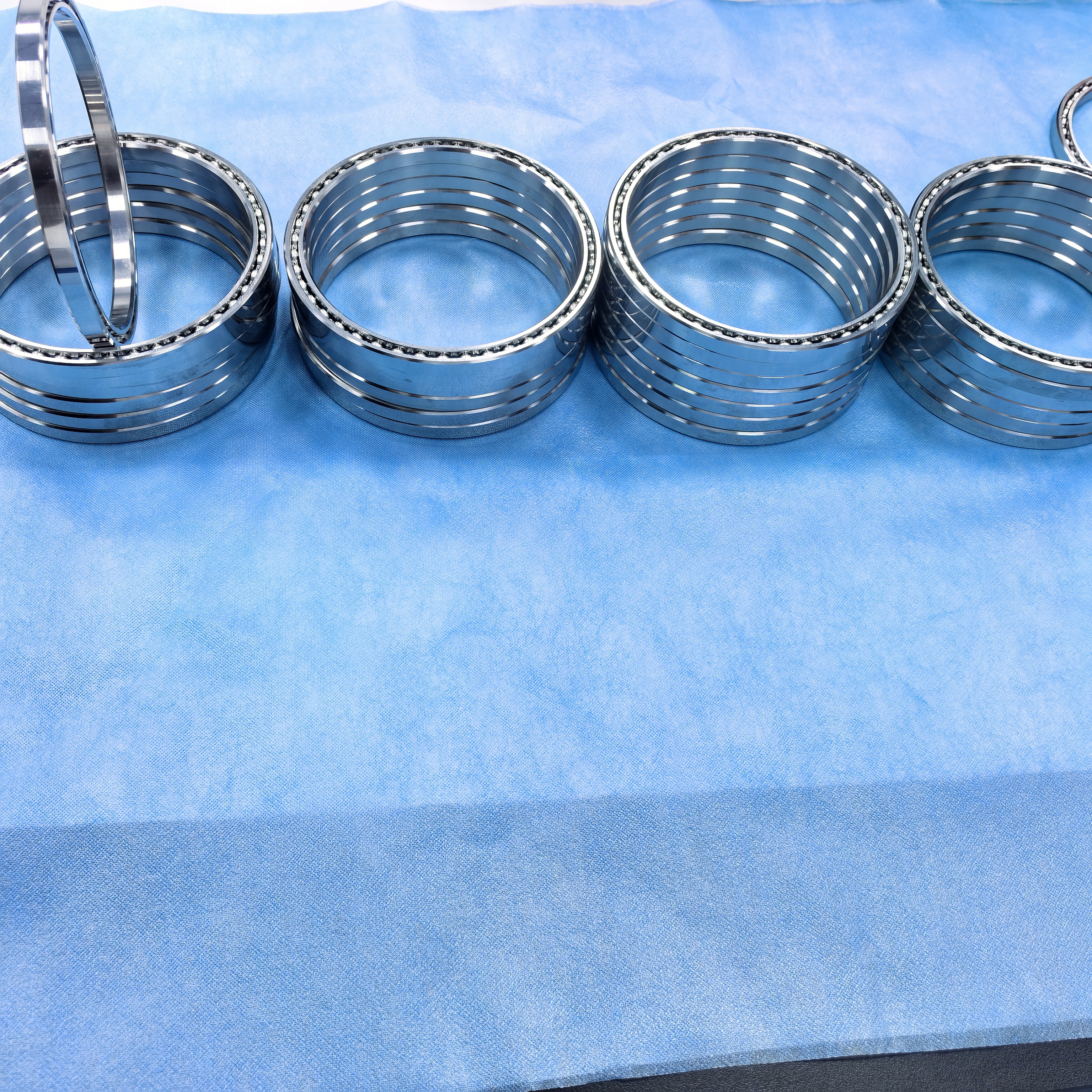
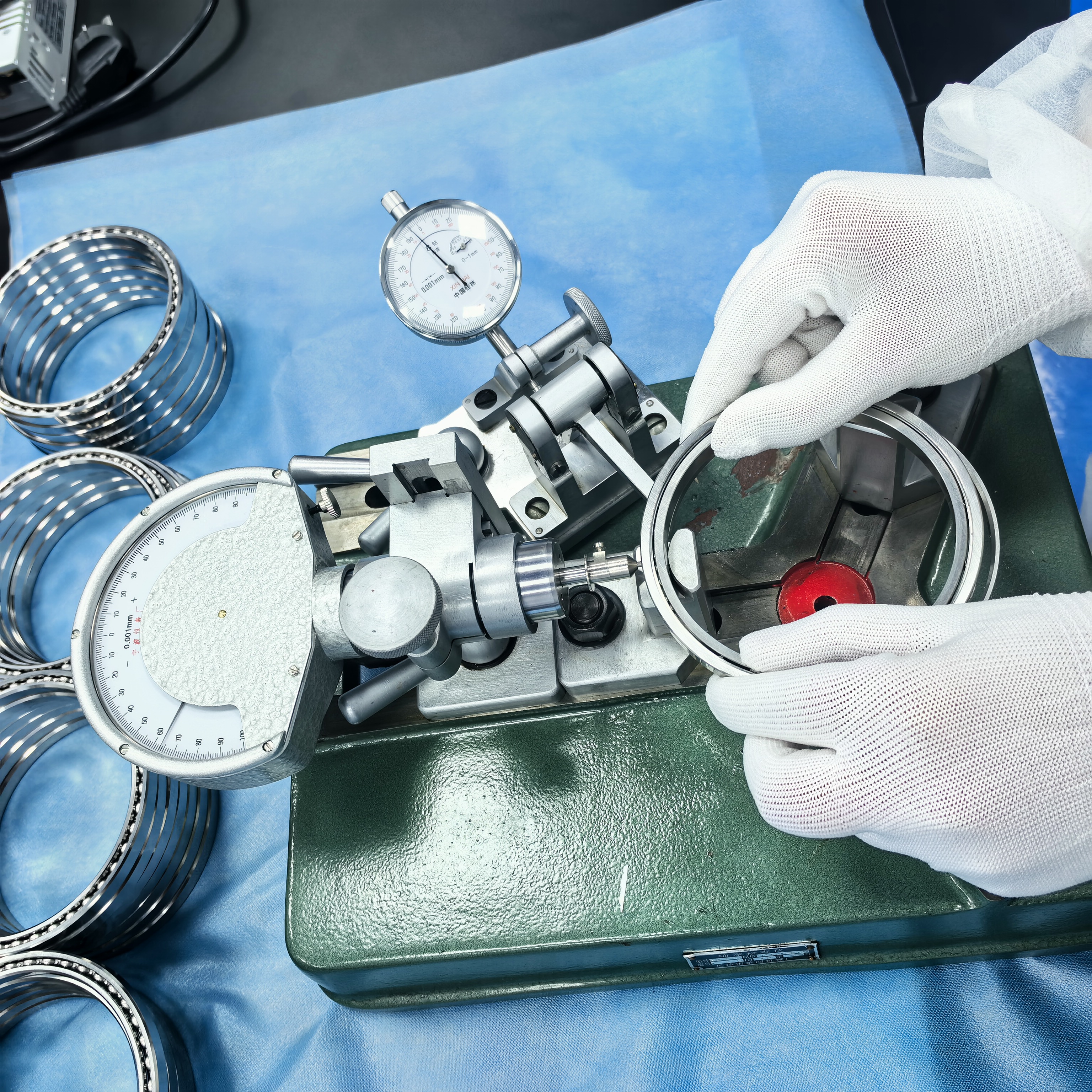
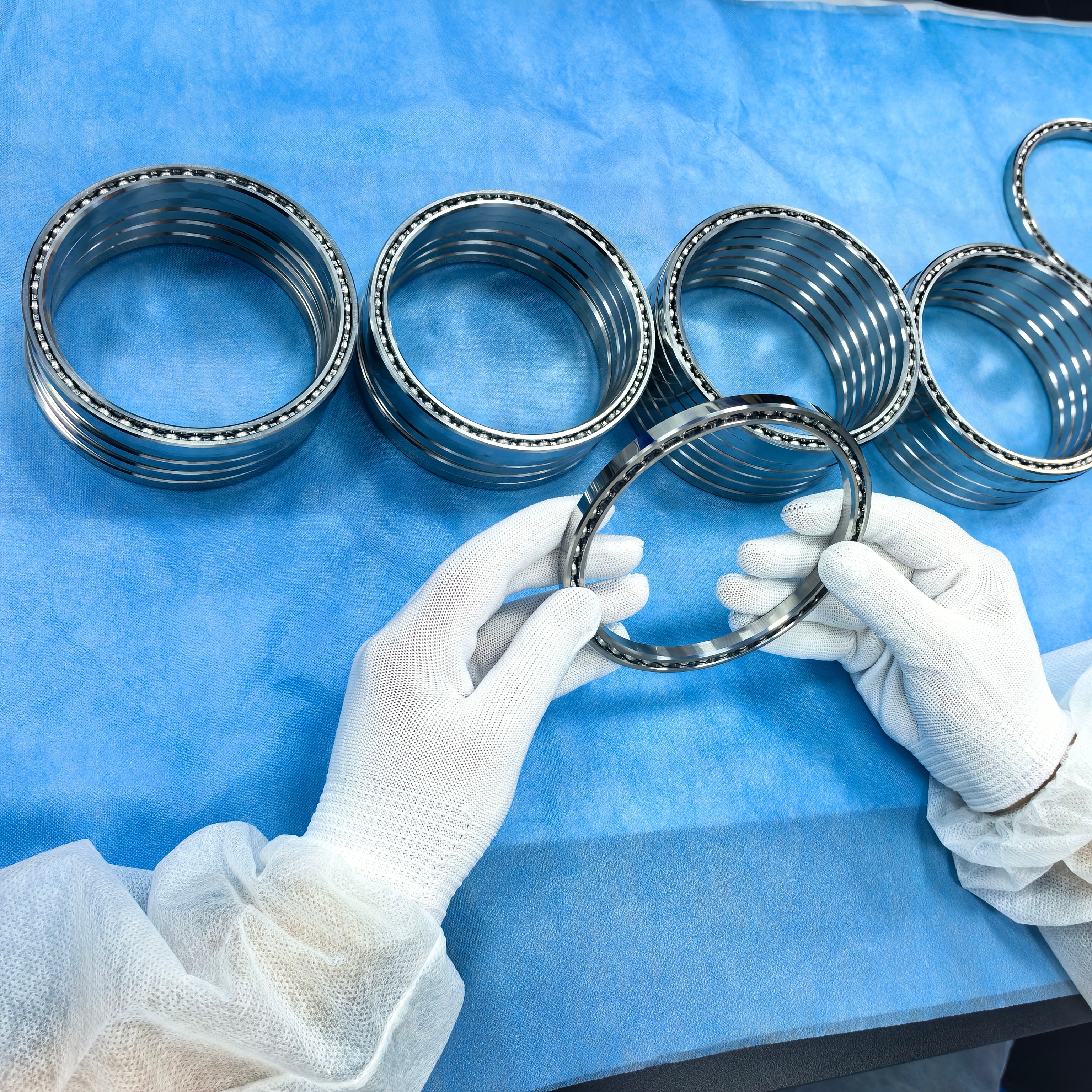
Thin Section Bearings exhibits stable dynamic operation, with different dynamic indicators corresponding to different precision grades P4 and P5.During operation, the rolling elements and raceways make smooth contact, resulting in low frictional resistance and good temperature control, allowing for long-term maintenance of medium-to-high-speed operation.The bearing rotational run-out is controlled within the standard range, and the vibration and noise values are low during high-speed operation.The structure is subjected to uniform stress, and the deformation is minimal under small and medium alternating loads, making it difficult to deviate from its operating posture.With a standard sealing and lubrication system, the lubrication film remains intact under dynamic operating conditions, preventing jamming and abnormal noise. The overall dynamic stability meets the continuous operation requirements of precision transmission equipment.
We also manufacture bearings made of 440C stainless steel—specifically model SC040AR0. Compared to bearings made of GCr15 bearing steel, stainless steel bearings offer the following advantages:
1. High hardness and wear resistance: After quenching, the hardness is HRC58–62. The dense chromium carbide structure provides wear and fatigue resistance, making it suitable for high-speed and high-load operating conditions.
2. Corrosion and rust resistant: Resistant to moisture, salt spray, fresh water, weak acids, and food and pharmaceutical solutions, superior to ordinary chrome steel, suitable for medical, food, and marine environments.
3. Wide temperature stability: Withstands temperatures from -60℃ to 300℃, and is not prone to deformation or performance degradation under high and low temperature environments, making it suitable for high and low temperature precision equipment.
4. High dimensional accuracy: It can be polished to Ra<0.05μm, and with the constant cross-section design, the rotational run-out is small and the positioning is accurate.
5. Superior performance: It is more rust-resistant and has a longer service life than 52100 chromium steel; it is harder, more wear-resistant, and can withstand heavy loads than 316L steel.