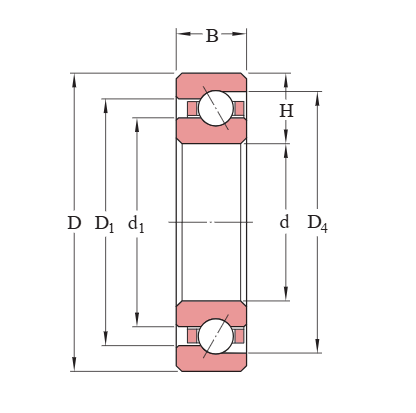
The KC060AR0 is an open-type, Slim-section bearing from the KC series, featuring a 30° contact angle. Featuring a brass cage, this bearing supports combined radial and unidirectional axial loads; it is compact and lightweight, offers high rotational precision, and is suitable for precision, space-constrained equipment such as robot joints, optical gimbals, and semiconductor turntables. When mounted in pairs, it can withstand bidirectional thrust loads.
Dimensions in Inches | Capacities in Pounds |
Approx.Wt. In lbs. |
Size | Land Diameters | Dynamic | Static |
Bore | Outside Dia. | L1 | L2 | C’BoreL3 | ISO Radial | Thrust | Radial | Thrust |
6.000 | 6.750 | 6.277 | 6.473 | 6.550 | 2,917 | 3,580 | 3,750 | 10,820 | .64 |
The biggest advantage of unified slim bearings is that they occupy very little radial space while maintaining stable rotation accuracy, making them suitable for various rotating mechanisms that pursue miniaturization. This type of bearing is often used in automated rotating platforms with small assembly spaces. High-precision models can meet the low-jitter requirements of optical lenses and chip detection equipment; Medical imaging rotating components use their thin structure to simplify the internal layout; aerospace precision components rely on their low weight to reduce the load on the entire machine. Selecting and adapting the accuracy level based on the equipment speed and load can meet the needs of long-term smooth operation.
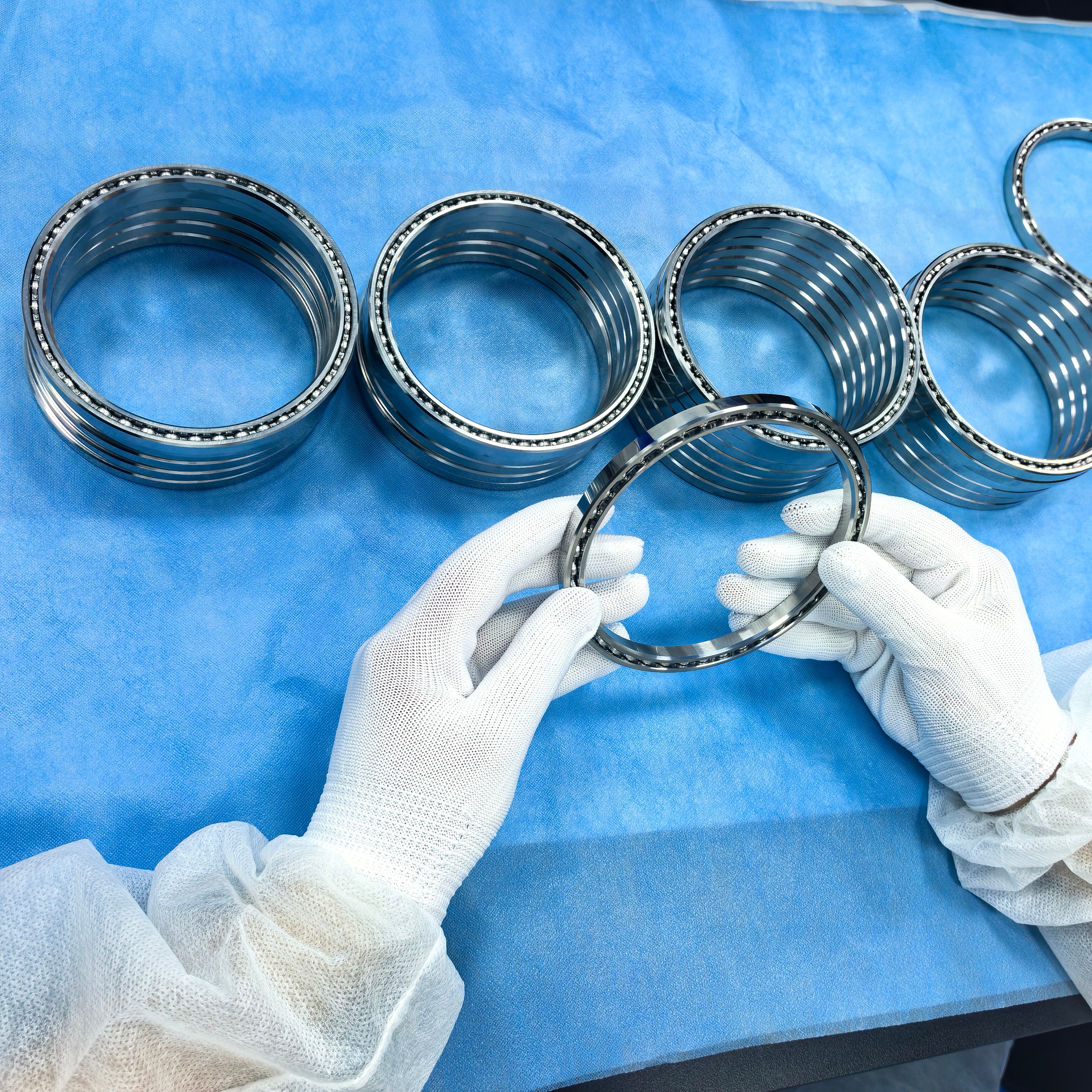
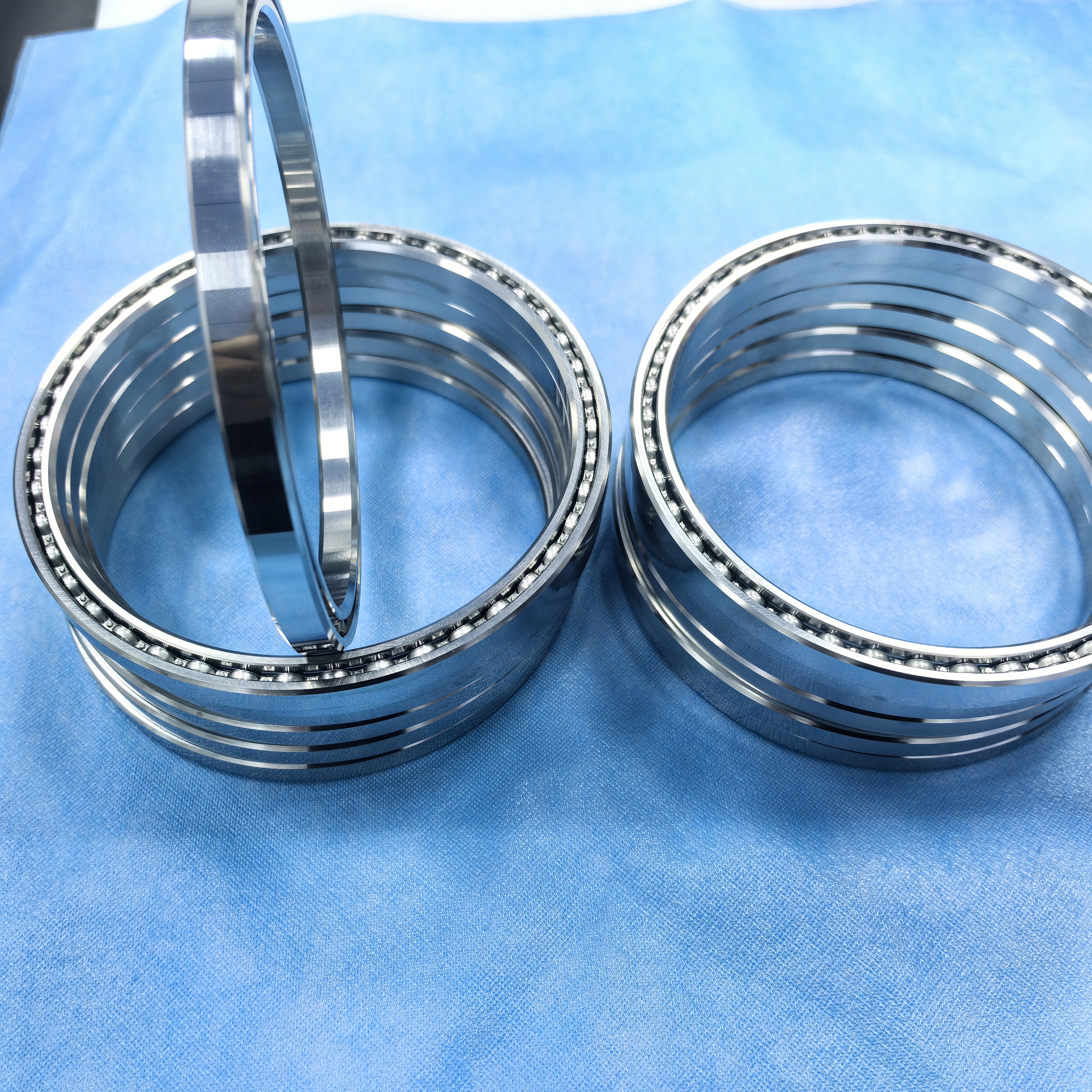
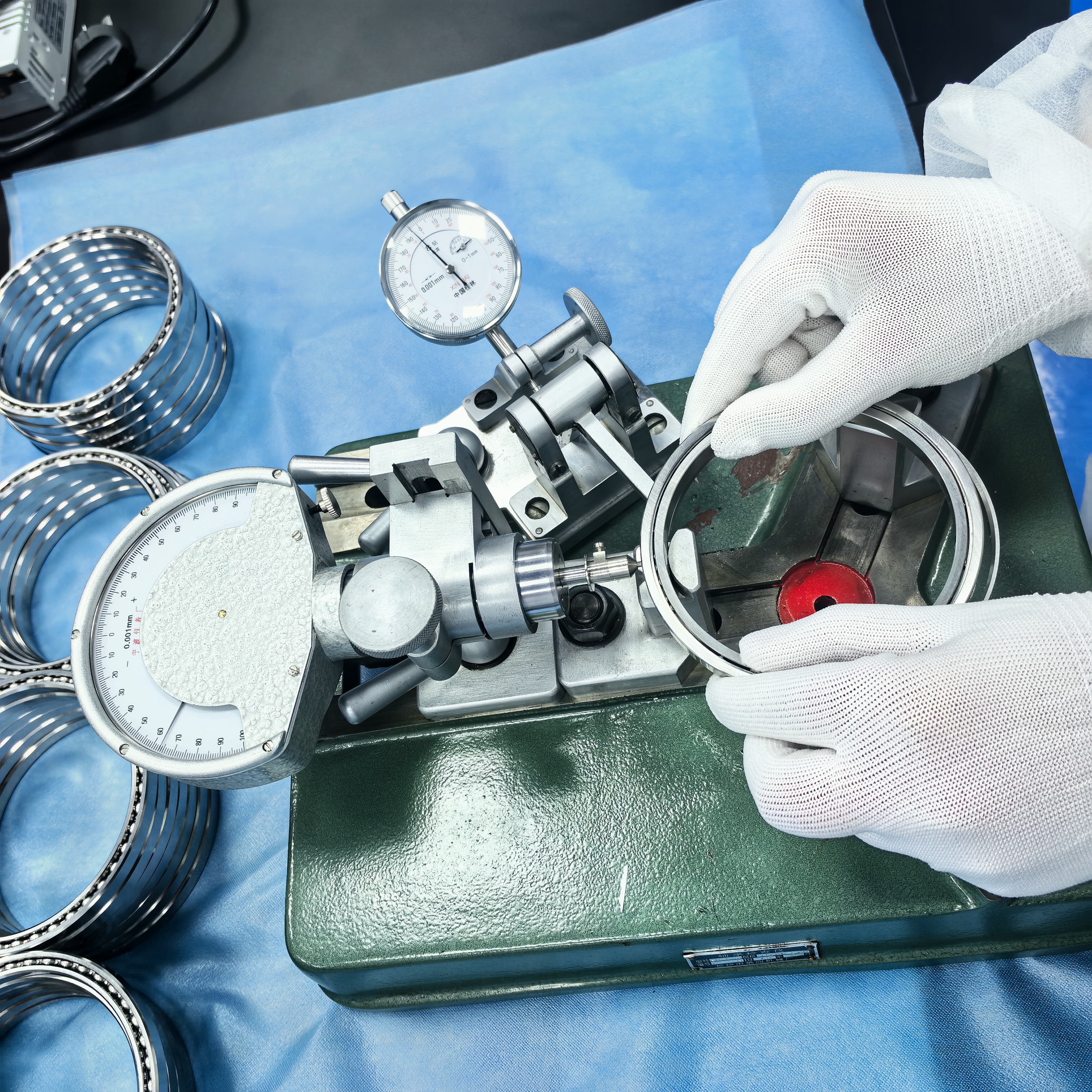
The mass production of Slim-section bearings incorporates standardized quality control procedures; incoming steel undergoes uniform spot checks for hardness and dimensional tolerances, and blanks with material defects are rejected. Following precision machining, raceway surface finish and cross-sectional thickness consistency are inspected on a batch-by-batch basis, while roundness and parallelism are verified using precision instruments. During the assembly stage, controls are implemented for steel ball sorting and lubricant fill quantity; samples are drawn from each batch to conduct tests for rotational runout and no-load temperature rise. Non-conforming products are isolated and reworked separately, and inspection data from every process stage is fully retained; this ensures that dimensional and precision variances within the same batch remain under control, consistently meeting uniform performance standards for mass-production assembly.
We also manufacture bearings made of 440C stainless steel—specifically model SC060R0. Compared to bearings made of GCr15 bearing steel, stainless steel bearings offer the following advantages:
1. High hardness and wear resistance: After quenching, the hardness is HRC58–62. The dense chromium carbide structure provides wear and fatigue resistance, making it suitable for high-speed and high-load operating conditions.
2. Corrosion and rust resistant: Resistant to moisture, salt spray, fresh water, weak acids, and food and pharmaceutical solutions, superior to ordinary chrome steel, suitable for medical, food, and marine environments.
3. Wide temperature stability: Withstands temperatures from -60℃ to 300℃, and is not prone to deformation or performance degradation under high and low temperature environments, making it suitable for high and low temperature precision equipment.
4. High dimensional accuracy: It can be polished to Ra<0.05μm, and with the constant cross-section design, the rotational run-out is small and the positioning is accurate.
5. Superior performance: It is more rust-resistant and has a longer service life than 52100 chromium steel; it is harder, more wear-resistant, and can withstand heavy loads than 316L steel.