1. Getting to know 440C Stainless Steel bearings: Material determines extraordinary performance
When it comes to bearings, many people think of ordinary bearing steel bearings, but in wet, hot or corrosive environments, 440C stainless steel bearings are the "durable ones". The core advantage lies in the special
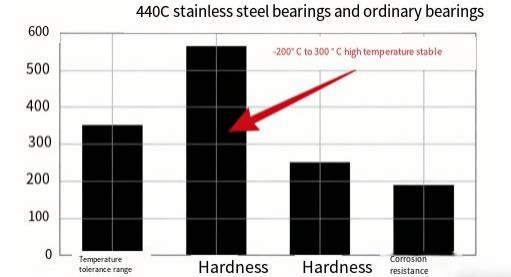
material of 440C martensitic stainless steel - 1.0% carbon, 17% chromium, and after quenching and low-temperature tempering, the hardness can reach HRC58-62, close to the hardness level of high-carbon tool steel, while retaining the corrosion-resistant nature of stainless steel.
Compared with the common 304 stainless steel, 440C has a higher carbon content and a hardness increase of more than 30%; Compared with ordinary bearing steel (GCr15), it has an inherent anti-rust ability, eliminating the need for additional electroplating or coating of protective layers and solving the rusting problem in damp environments at its root. This "hard but not brittle, corrosion-resistant" material property makes 440C stainless steel bearings the "all-rounder" in precision machinery.
2. Core Advantage: Three key features unlock complex working conditions
Super corrosion resistance, "no rust" in damp environments
440C stainless steel bearings can resist the erosion of media such as
fresh water, seawater, weak acids and weak bases. Even if they are immersed in a humid environment for a long time, there will be no red rust or pitting on the inner and outer rings and rolling elements. This property makes it irreplaceable in scenarios such as food processing, aquaculture, and outdoor equipment - for example, conveyor belt bearings in food machinery, which are frequently exposed to cleaning water and acid-base cleaners, and the 440C material can prevent the bearings from rusting and contaminating food.
High hardness and wear resistance, doubling the service life
After professional heat treatment, the hardness of the inner and outer rings of 440C stainless steel bearings can reach around HRC60, and the hardness of the rolling elements is even higher, capable of withstanding
greater radial and axial loads. Compared with ordinary stainless steel bearings (such as 304 material, which has a hardness of only HRC20-30), its wear resistance is enhanced by more than five times, and it can effectively reduce wear and extend service life in high-speed rotation and frequent start-stop conditions. For example, in motor spindles and precision instrument transmission systems, 440C bearings can run stably for tens of thousands of hours without replacement.
3 Wide temperature range adaptation, stable in extreme environments
The 440C stainless steel bearing has an extremely wide operating
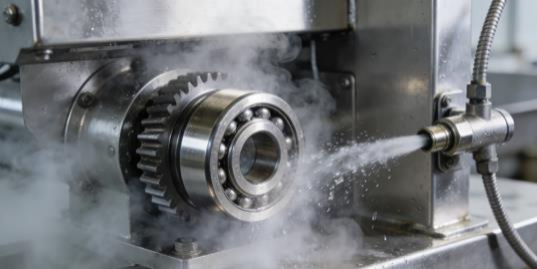
temperature range and can operate normally in an environment of -200 。C to 300 。C. At low temperatures, the material does not become brittle and the bearing rotates smoothly; In high temperatures, its hardness and precision remain stable without jamming due to thermal expansion and contraction. This advantage allows it to play a crucial role in extreme scenarios such as refrigeration equipment, high-temperature ovens,
aerospace - for example, in the conveying machinery bearings of low- temperature cold storage, or in the transmission systems of high-temperature kilns, 440C bearings can maintain reliable performance.

3. Structural Analysis: Precision design Empowers superior performance
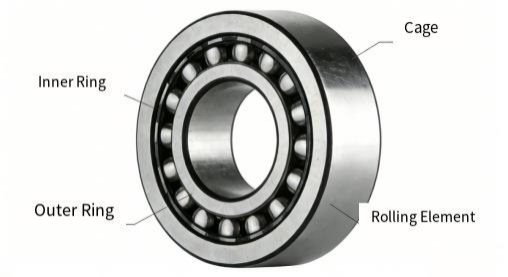
The structure of the 440C stainless steel bearing is similar to that of the common deep groove ball bearing, mainly consisting of inner and outer rings, rolling elements, and cage, but each component is specially
designed:
• Inner and outer rings : Made of 440C stainless steel forgings, with precision grinding and polishing, the surface roughness is extremely low (Ra≤0.02 μm), reducing friction between the rolling elements and the inner and outer rings;
• Rolling elements : mostly 440C stainless steel balls or rollers, silicon carbide ceramic balls can also be used, quenched heat treatment and superfine grinding, roundness error controlled within 0.1 μm to ensure
rotational accuracy;
• Cage : Commonly made of stainless steel, nylon or phenolic resin, depending on the condition - stainless steel cages are suitable for high-temperature and highly corrosive environments, while nylon cages can reduce operating noise and improve rotational smoothness.
In addition, some 440C stainless steel bearings also adopt sealing designs (such as double-sided tape sealing and iron sealing), with high- temperature grease installed inside to prevent dust and moisture from entering the bearing interior, further enhancing the protective performance and service life.
4. Application scenarios: Permeating every aspect of life and industry
Due to its outstanding comprehensive performance, 440C stainless steel bearings have a wide range of applications, covering industrial production, daily life, special fields and many other aspects:
• Industrial : Food processing machinery, chemical equipment,
pharmaceutical machinery, sewage treatment equipment, outdoor wind power equipment, high/low temperature equipment;
• Everyday life : Household water purifiers, washing machines, air conditioning outdoor units, bicycle bearings, fishing gear reels;
• Special areas : Aerospace equipment, medical devices (such as surgical instrument transmission components), Marine exploration equipment, nuclear industry equipment.
5. Key points for selection: Avoid misconceptions and choose the right bearings
When choosing 440C stainless steel bearings, pay attention to the following 3 points to avoid improper selection affecting use:
Identify the requirements of the working conditions : Select based on parameters such as humidity, temperature, load size, and speed of the working environment - for example, high-precision grades (such as P5, P4 grades) should be chosen for high-speed rotation scenarios, and sealing structures and special greases should be matched for strong corrosive environments;
Distinguish the material : There are some "fake 440C bearings" on the market that use ordinary stainless steel instead, which can be identified by hardness testing (measured with a hardness tester, hardness ≥HRC58 is qualified) or magnetic detection (440C material has weak magnetism, 304 material has no magnetism);
Pay attention to the precision grade : Bearing precision is divided into grades P0, P6, P5, P4, etc. The higher the precision, the smaller the rotational error - for precision instruments and high-end equipment, it is recommended to choose P5 grade and above precision, while for ordinary industrial equipment, P0 or P6 grade is sufficient.