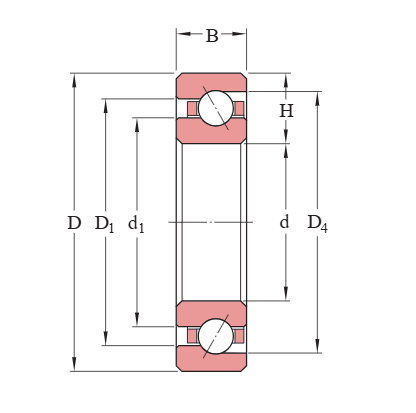
The KC045AR0 is an open-type, constant-section, 30° angular contact bearing. It features GCr15 bearing steel for the rings and balls, a brass cage, and an R0 standard small internal clearance. Capable of withstanding combined radial and unidirectional axial loads; when paired and preloaded, they can handle bidirectional thrust. Their compact, lightweight profile saves installation space, making them suitable for robotic arms, optical gimbals, and various precision inspection turntables.
Dimensions in Inches | Capacities in Pounds |
Approx.Wt. In lbs. |
Size
| Land Diameters | Dynamic | Static |
Bore | Outside Dia. | L1 | L2 | C’BoreL3 | ISO Radial | Thrust | Radial | Thrust |
4.500 | 5.250 | 4.777 | 4.973 | 5.052 | 2,637 | 2,990 | 2,860 | 8,270 | .49 |
Slim section bearings are composed of four parts: inner ring, outer ring, rolling elements, and cage. The cross-sectional dimensions of the inner and outer rings are uniform, the cross-section is standard square, and the wall thickness is uniform and thin. The inner and outer ring raceways are integrally formed, the raceway size is fixed, and the cross-sectional specifications remain unchanged when the inner diameter changes. The rolling elements are small steel balls, evenly arranged between the inner and outer raceways; the cage separates the steel balls, limits the distance between the rolling elements, and avoids mutual friction. There is no widening or thickening structure in the inner and outer rings, the overall wall thickness is consistent, the raceway surface is regular, and the cross-sectional parameters of the parts are uniform. The entire set of bearings only differs in inner diameter among specifications, and the rest of the structural cross-section dimensions are exactly the same.
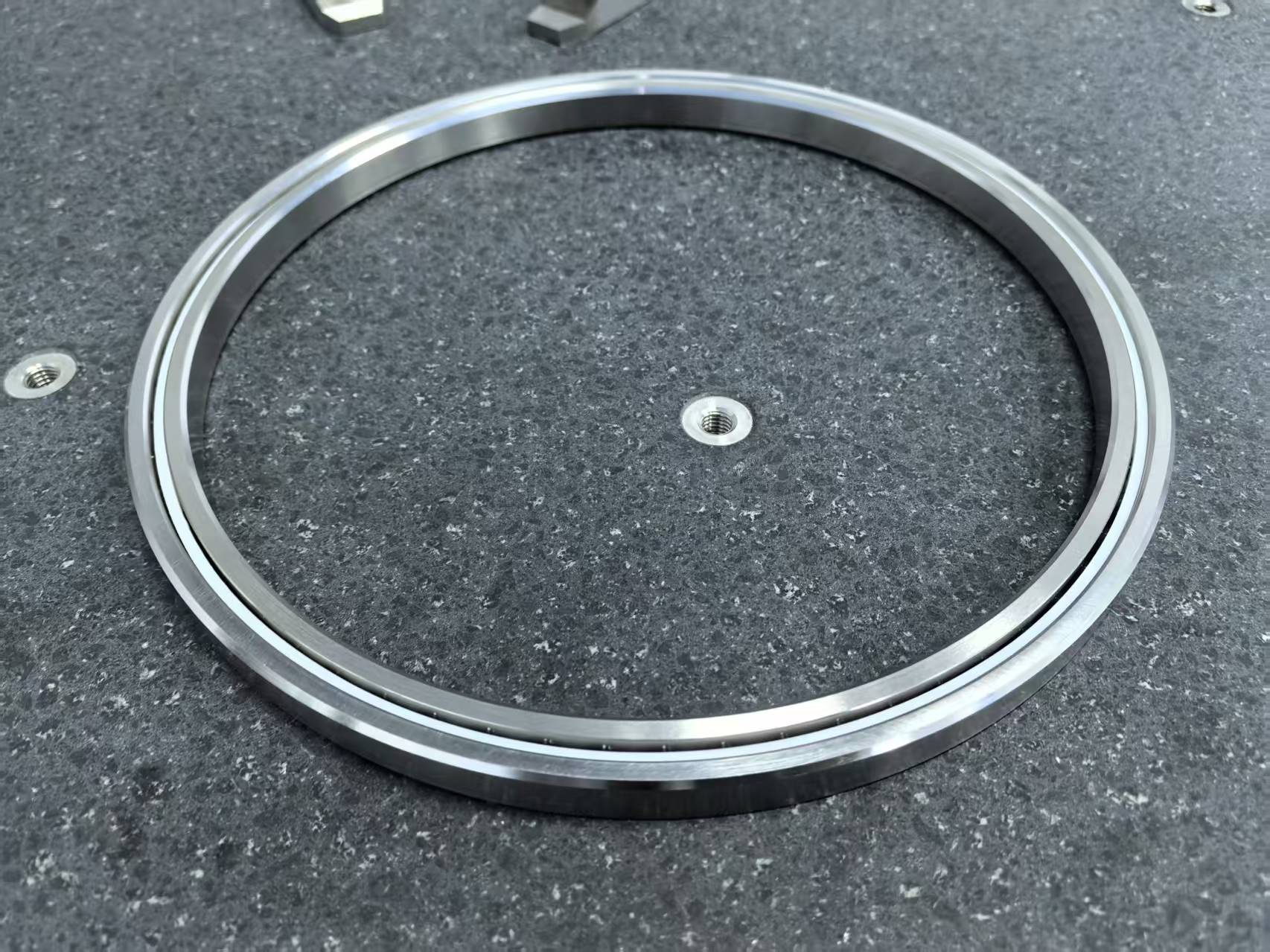
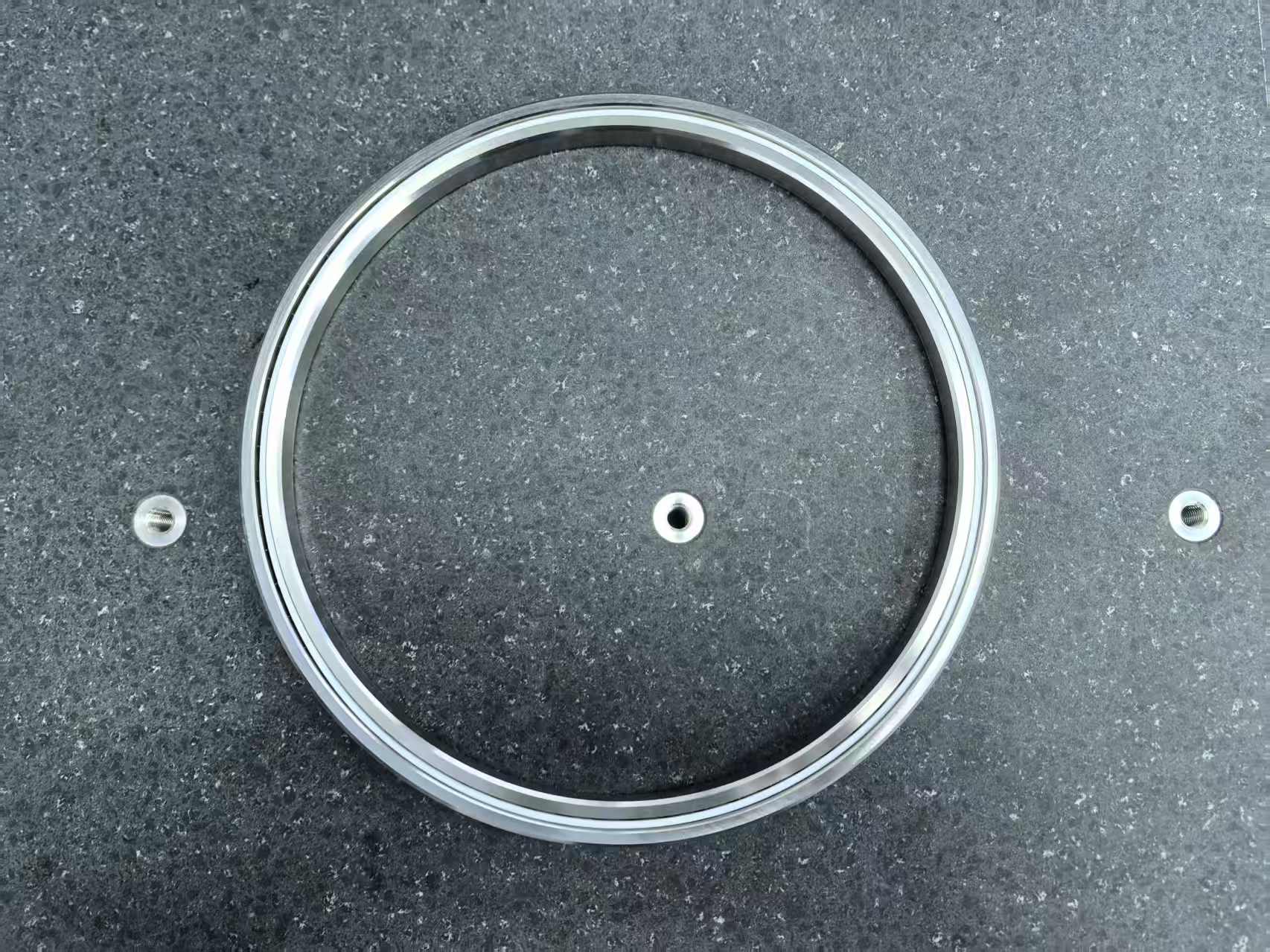
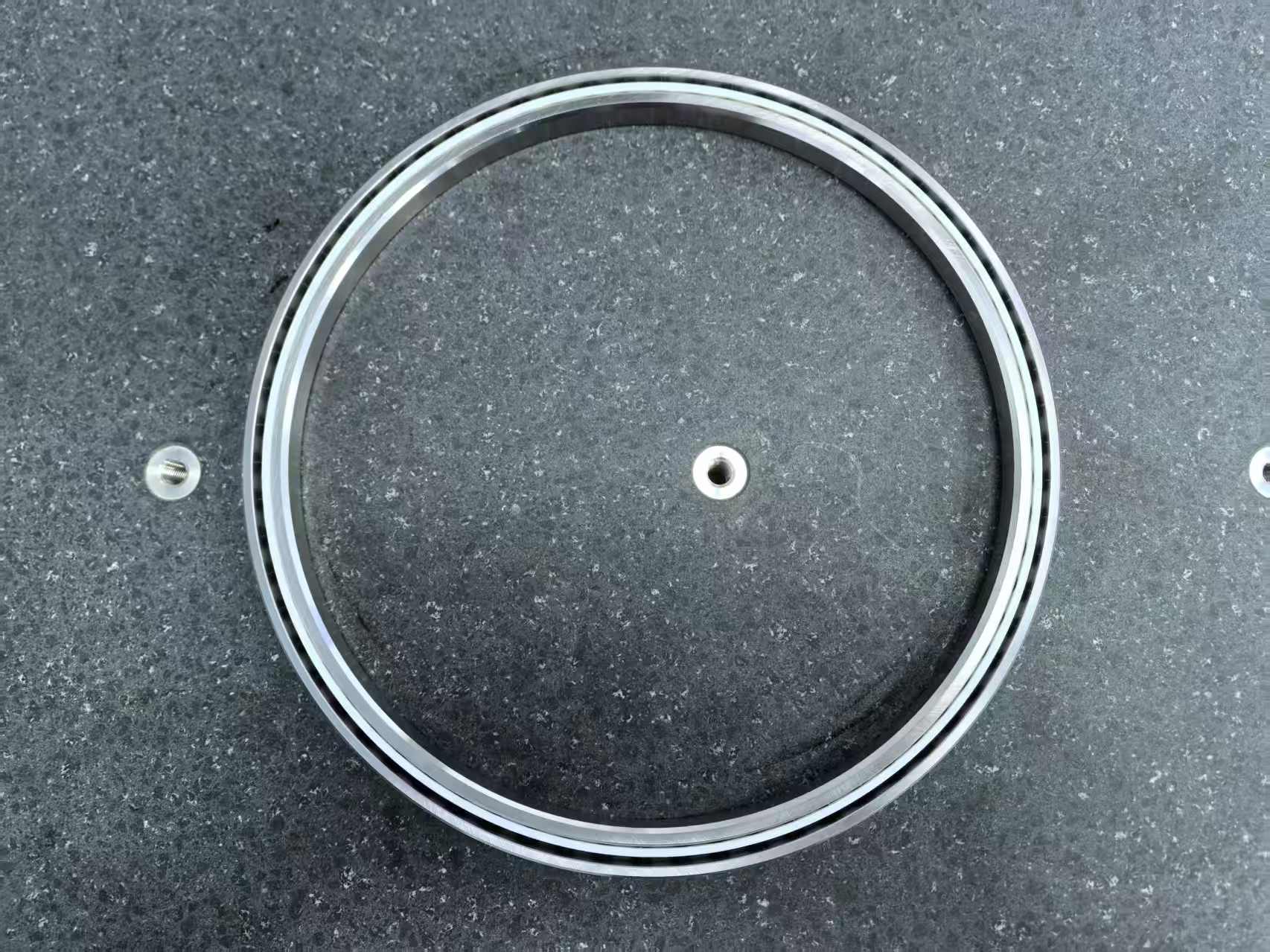
The mainstream material of thin section bearing rings and steel balls is GCr15 bearing steel, which has high hardness and excellent wear resistance after heat treatment. Corrosion usage scenarios are made of 440C stainless steel, which has strong anti-rust ability and can meet the needs of humid and medium-containing working environments. The material selection of rolling elements and rings should be consistent to ensure that the materials of friction pairs are uniform. Cages are divided into two categories: brass and engineering plastics. The brass material is wear-resistant and not easy to deform, while the plastic material is light in weight and has low operating noise. The thermal expansion coefficients of all supporting materials are compatible with each other and adapt to the thin-walled structure of the bearing to ensure stable operation of the bearing.
TKW also manufactures 440C stainless steel thin-section bearings (model SC042AR0). Compared to thin-section bearings made from other materials, the 440C stainless steel version offers the following characteristics:
1. High hardness and wear resistance: After quenching, the hardness is HRC58–62. The dense chromium carbide structure provides wear and fatigue resistance, making it suitable for high-speed and high-load operating conditions.
2. Corrosion and rust resistant: Resistant to moisture, salt spray, fresh water, weak acids, and food and pharmaceutical solutions, superior to ordinary chrome steel, suitable for medical, food, and marine environments.
3. Wide temperature stability: Withstands temperatures from -60℃ to 300℃, and is not prone to deformation or performance degradation under high and low temperature environments, making it suitable for high and low temperature precision equipment.
4. High dimensional accuracy: It can be polished to Ra<0.05μm, and with the constant cross-section design, the rotational run-out is small and the positioning is accurate.
5. Superior performance: It is more rust-resistant and has a longer service life than 52100 chromium steel; it is harder, more wear-resistant, and can withstand heavy loads than 316L steel.